- Most lower back pain is not a sign of serious damage, and many episodes improve within weeks.
- Avoid prolonged bed rest. Keep gently active at a level you can manage.
- Scans are not usually needed straight away and must be interpreted alongside your symptoms.
- Some symptoms need emergency help. Read the warning signs below.
- If pain is not improving, is affecting daily life or worries you, seek assessment.
First, some reassurance
Lower back pain is common. It can be frightening, especially when a simple movement suddenly hurts, but pain does not automatically mean your back has been seriously damaged. Many episodes start to improve within a few weeks.
That reassurance should not dismiss what you are feeling. Your symptoms matter, and so does checking for the small number of warning signs that need urgent attention. The aim is to understand what is happening and help you move with more confidence—not tell you to ignore pain. NHS: Back pain
So what is actually causing it?
Often, no single cause can be identified. This is sometimes called non-specific low back pain. The useful questions are what your symptoms are doing, how they affect you, and whether there are signs that need further investigation.
Physical symptoms, worries about movement and the demands of everyday life can interact. A helpful plan takes account of the whole picture rather than assuming that one scan finding explains everything. NICE NG59: Low back pain and sciatica — recommendations
MRI scans of people without back pain commonly show disc bulges and other degenerative changes, with these findings becoming more common with age. A scan finding is not automatically the cause of pain—but it should not automatically be dismissed either. It needs to fit the clinical picture. Brinjikji et al. (2015): Imaging findings in people without symptoms
What actually helps
Keep moving in manageable amounts. Try short walks, change position and continue ordinary activities as you are able. You do not need to push through severe pain, but spending long periods in bed is generally unhelpful. NHS: Back pain
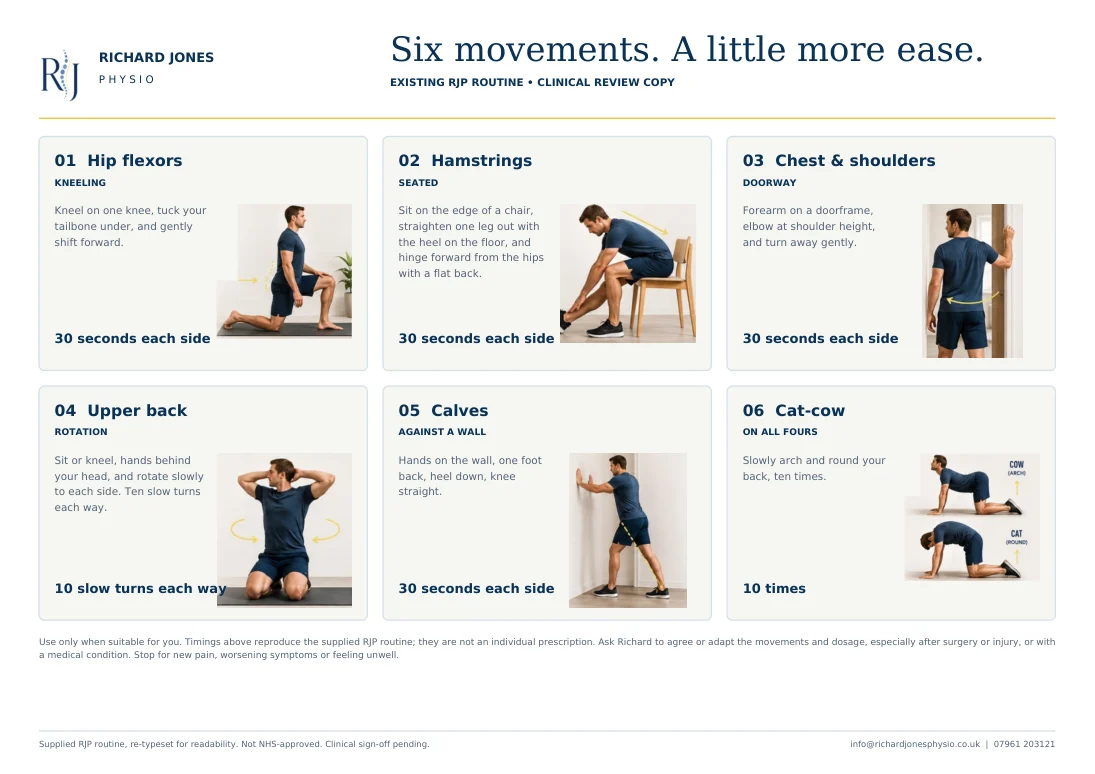
Make a gradual plan. Exercise should suit your symptoms, preferences and abilities. Build activity rather than trying to “fix” your back with one perfect stretch. Hands-on treatment, when appropriate, belongs alongside an active approach rather than replacing it. NICE NG59: Low back pain and sciatica — recommendations
Discuss work and everyday tasks. Modified duties or temporary adjustments may help you stay involved or return gradually. This is not a demand to work through unsafe or unmanageable symptoms.
Think beyond a painful spot. Tell your clinician if sleep, worry or daily pressures are making coping harder. These are worth discussing without suggesting the pain is imaginary.
Use comfort measures sensibly. Some people find a wrapped heat pack helpful for stiffness or spasm. Protect your skin and do not use heat where sensation is reduced without advice. Water-based exercise may be an option after assessment; it is not necessary for every episode.
What is less useful than you might hope
Waiting for an MRI before taking any sensible action is not usually necessary. NICE advises against routine imaging in a non-specialist setting and recommends specialist imaging when the result is likely to change management. NICE NG59: Low back pain and sciatica — recommendations
It is also unhelpful to be given a frightening explanation without evidence, or a promise that one treatment will guarantee a cure. Ask what an explanation means for you and how the plan will help you return to everyday activity.
The warning signs that need urgent attention
Call 999 or go to A&E
Get emergency help if back pain comes with new bladder or bowel changes (including difficulty passing urine or loss of control), loss of feeling around the genitals or anus, or pain, tingling, weakness or numbness in both legs. Changes in sexual sensation or function can also be relevant.
Back pain with chest pain, or following a serious accident, also needs emergency assessment. Do not wait for a physiotherapy appointment. Do not drive yourself to A&E. NHS: Back pain
Ask for urgent medical advice
Seek an urgent GP appointment or contact NHS 111 for back pain that becomes suddenly severe, worsens quickly, or comes with feeling feverish, shivery or generally unwell.
Unexplained weight loss, pain that persists at rest or at night, or a current or past cancer diagnosis also needs medical assessment. With a cancer history and new severe or progressive back pain, contact your cancer team or an urgent GP service promptly; neurological or bladder/bowel symptoms remain an emergency. NICE NG234: Spinal metastases and spinal cord compression
This is not a complete diagnostic checklist. Seek help sooner whenever you are seriously concerned.
When should you see a physiotherapist?
If your pain is not beginning to settle after a few weeks, keeps returning, travels down your leg or interferes with ordinary activities, an assessment can help clarify the next step. You do not have to wait a fixed number of weeks if you are worried.
You can contact Richard directly about a private appointment. He can assess you, explain his findings and discuss a plan or referral where needed. An initial enquiry does not require you to email your full medical history.
Frequently asked questions
Should I rest if my back hurts?
Brief changes to activity may help during a flare-up, but avoid prolonged bed rest. Continue manageable movement and seek advice if symptoms are severe, worsening or have warning signs.
Do I need an MRI scan?
Not usually as the first step. A clinician can decide whether imaging would change your care or whether warning signs require urgent investigation.
How long does lower back pain take to settle?
Many episodes improve over a few weeks, but recovery varies. Seek assessment if it is not improving, keeps recurring or affects your daily activities.
Is walking good for back pain?
For many people, walking is a manageable way to stay active. Start with a comfortable amount, adjust to your symptoms and build gradually.
Can hydrotherapy help my back?
It may help some people exercise more comfortably. It requires screening and an individual plan, and it is not essential or suitable for everyone.
If your back is not settling, let’s work out your next step.
Talk to Richard about an assessment and the right next step for you.
Enquire about an assessment info@richardjonesphysio.co.ukWritten by Jacqui Cox. General information only; not individual medical advice. Do not delay urgent care because of this article.
Sources & further reading
References checked 10 November 2026. External guidance supports the information; it does not endorse the practice or replace individual assessment.