
- Regular flexibility exercises can help maintain or improve comfortable movement.
- Warm up with controlled movement before exercise; static stretches can fit afterwards or in a separate session.
- A useful stretch feels gentle, not sharp, burning or nervy.
- There is no single correct hold time for every stretch or person.
- Stretching is one part of staying active—not a substitute for strength, balance or assessment of persistent pain.
The honest truth about stretching
Stretching is useful, but it is not a cure-all. It can help you maintain or improve your range of movement. It should not be sold as a guarantee against injury or as the answer to every painful joint. NHS: Flexibility exercises Behm et al. (2016): Stretching, performance, range of motion and injury
The practical goal is not to win a toe-touching contest. It is to reach a shelf, get your shoes on or turn comfortably when looking behind you. A routine you can repeat is more useful than an ambitious one that never leaves the page.
What does stretching actually do?
Flexibility exercises take a joint or muscle group through a comfortable range. Regular practice can improve the range available, but the response depends on the movement, dose and individual. Build gradually rather than trying to force a large change in one session. NHS: Flexibility exercises
Stiffness can have several causes. It is not proof that you have damaged something, and it is not always caused by sitting or getting older. New or persistent stiffness, swelling or pain deserves proper assessment rather than an assumption that you simply need to stretch harder.
Flexibility or mobility—what’s the difference?
A useful everyday distinction is that flexibility describes the range available, while mobility also considers your ability to use movement with control. The terms overlap; neither is a diagnosis.
Think about what you want to do more comfortably. That might need a combination of range, strength, balance and confidence—not just a deeper stretch.
When should you stretch?
Before exercise: start with movement
Begin with a gradual warm-up: walking or marching, gentle shoulder circles and controlled movements relevant to what you are about to do. Increase the effort progressively rather than launching straight into a demanding activity. NHS: How to warm up before exercising
Long static holds immediately before explosive effort can temporarily reduce performance in some circumstances. The effect depends on the duration and the rest of the warm-up; it does not mean that every brief static stretch before exercise is harmful. Behm et al. (2016): Stretching, performance, range of motion and injury
After exercise, or in a separate session: gentle holds can fit
Ease into a mild stretch and breathe normally. The right duration varies: NHS routines include some brief holds and others of around 15–20 seconds. A comfortable hold of around 20–30 seconds may suit some movements, but 30 seconds is not a magic threshold and shorter holds are not automatically pointless. Follow an individually prescribed programme where you have one. NHS: How to stretch after exercising NHS: Flexibility exercises
A simple six-movement routine
The RJP ten-minute routine brings together six familiar movements. Treat “ten minutes” as a convenient session guide, not a requirement or a promise of benefit.
Get advice before trying it if you have pain, an injury, recent surgery, a medical condition, pregnancy-related concerns or difficulty getting on and off the floor. Use a stable support and a smaller range where needed. The following is a description of the routine for review, not an individual prescription.
- Hip flexors, kneeling. From a supported half-kneeling position, gently tuck your pelvis and shift forward a little. Do not force the lower back into an arch. A standing alternative may be needed if kneeling is uncomfortable.
- Hamstrings, seated. Sit securely near the front of a stable chair, extend one leg with the heel supported and lean forward gently from the hips. Stop if you feel sharp or radiating symptoms rather than a mild stretch.
- Chest and shoulders, doorway. Rest a forearm comfortably against a doorway and turn away gently. Adjust the height or leave it out if it provokes shoulder symptoms; do not force the arm backwards.
- Upper-back rotation. Sit in a stable position and turn slowly to each side within a comfortable range. Cross your arms over your chest if placing hands behind your head is uncomfortable. Avoid trying to reach a fixed end point.
- Calves, against a wall. Use the wall for support, place one foot behind you and gently lower that heel while keeping the back knee comfortable. Check your footing and avoid bouncing.
- Cat-cow, on all fours. Slowly alternate a small rounding and arching movement through your back. Do not push to the extremes. Ask for a seated or standing alternative if your wrists, knees or balance make the position unsuitable.
The original chart suggests 30-second holds for the static stretches and ten slow repetitions for the moving exercises. Those are source-chart instructions for Richard to review, not a universal starting dose. A shorter or smaller version may be more appropriate for you.
Where stretching is not the answer
If a painful area is not improving, repeatedly pulling harder is not a plan. Stop movements that cause pain or make you feel unwell, and get advice. A physiotherapist can help work out whether you need a different exercise, strengthening, a change in load or a medical assessment. NHS: How to warm up before exercising
A little comfortable movement can be a useful habit. It should not become a test you have to pass or something that overrides your symptoms.
The six-movement chart
Printable A4 PDF · General information, not an individual prescription.
Download the chart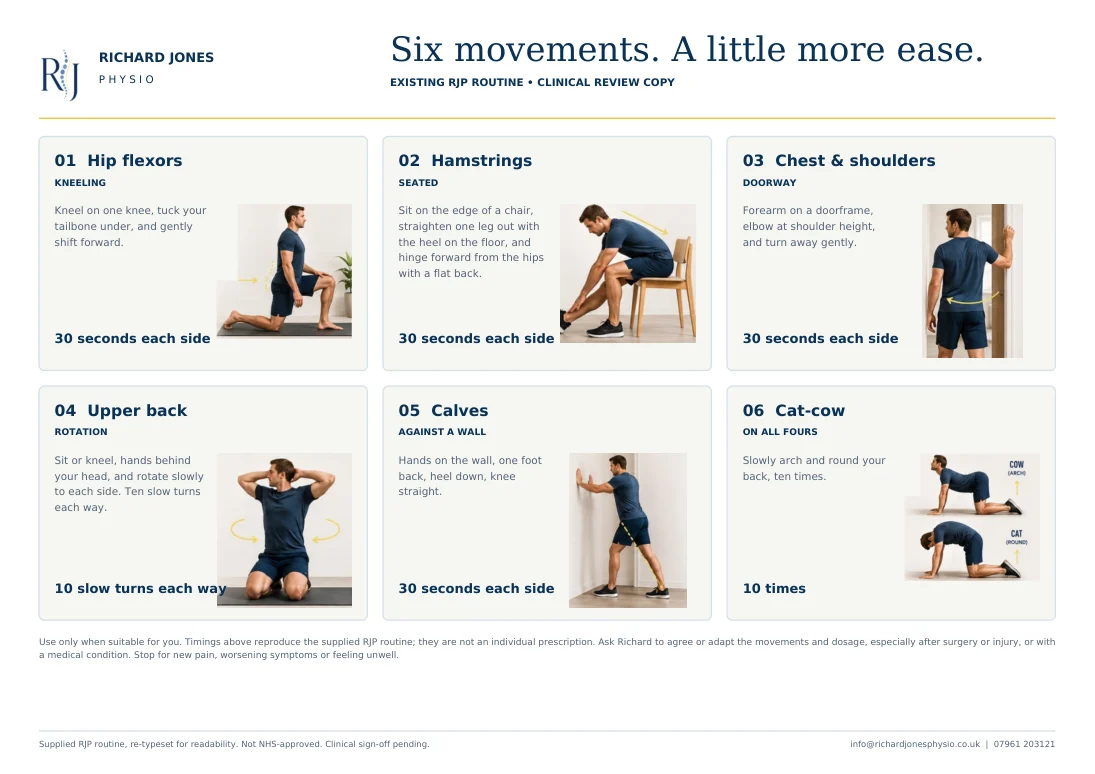
Frequently asked questions
How long should I hold a stretch?
There is no universal duration. Some NHS flexibility exercises use short holds; other routines use 15–20 seconds. Use a gentle, comfortable hold and follow the advice given for your particular exercise.
Should I stretch before exercise?
Start with a gradual, movement-based warm-up. Long static holds may not suit an immediate explosive effort, but the advice depends on your activity and the full warm-up.
Should stretching hurt?
No. Aim for a mild stretch, not sharp, burning or radiating pain. Stop if it hurts or you feel unwell, and ask for advice if symptoms persist.
How often should I stretch?
Choose a manageable routine. NHS flexibility guidance suggests at least twice a week, alongside other activity. More frequent gentle practice may suit some people; daily ten-minute sessions are not compulsory.
Can stretching fix my back pain?
It may form part of a suitable programme, but it is not a diagnosis or guaranteed cure. Persistent or worsening pain needs assessment; emergency symptoms need urgent medical care.
Stretching regularly, but something still isn’t right?
Talk to Richard about an assessment and the right next step for you.
Enquire about an assessment info@richardjonesphysio.co.ukWritten by Jacqui Cox. General information only; not individual medical advice. Do not delay urgent care because of this article.
Sources & further reading
References checked 10 November 2026. External guidance supports the information; it does not endorse the practice or replace individual assessment.